

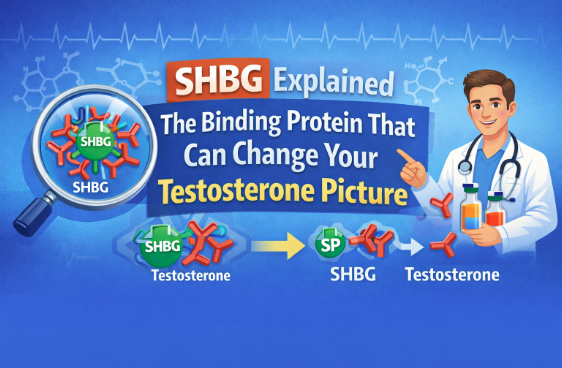
The Binding Protein That Can Change Your Testosterone Picture
You were told your testosterone is normal, but you still feel awful
You are tired no matter how much you sleep.
Your workouts are not working anymore.
Your belly weight will not go away.
You do not feel like yourself.
Your labs come back and your doctor says everything looks fine.
Patients tell us this all the time.
“My testosterone is normal but I feel terrible.”
“I’m gaining weight for no reason.”
“I feel like my body is stuck.”
This is often where SHBG gets missed.
What Is SHBG in Plain Language?
SHBG stands for sex hormone binding globulin.
Think of it like a lock.
SHBG grabs onto your testosterone and holds it tight.
When that happens, your body cannot use it.
So even if your total testosterone looks normal, your usable testosterone may be low.
That is why you can feel exhausted, foggy, and inflamed even with “normal” labs.
How SHBG Affects Weight Loss
This part is rarely explained.
When SHBG is high, free testosterone drops.
That means:
- Less muscle
- Slower metabolism
- More fat storage
- Lower motivation
Patients say things like:
“I eat less than I used to and still gain weight.”
“I work out but nothing changes.”
“I feel puffy and soft.”
This is not a willpower problem.
It is a hormone signaling problem.
Why Conventional Medicine Often Misses SHBG
In most insurance based care, SHBG is not even tested.
Doctors often look at one number and move on.
If total testosterone is in range, the visit is over.
No one explains:
- How binding proteins affect hormones
- Why symptoms matter
- Why weight loss feels impossible
You leave feeling ignored and frustrated.
How Functional Medicine Looks at the Full Testosterone Picture
Functional medicine does not stop at one lab.
We use advanced testing to look at:
- Total testosterone
- Free testosterone
- SHBG levels
- Cortisol and stress
- Inflammation markers
We connect these labs to how you actually feel.
That is where answers start to make sense.
Is Tirzepatide a Peptide and Why People Look for It
Yes. Tirzepatide is a peptide.
Peptides are small messengers that tell your body how to act.
Semaglutide and tirzepatide help control appetite and blood sugar.
Many people ask about these because weight loss feels impossible.
Patients tell us:
“I just want something to work.”
“I don’t want to be stuck on meds forever.”
“I want to fix the root cause.”
Peptides can help short term for some people.
They do not fix high SHBG or hormone binding issues.
Supporting the Body So Hormones Can Work
In functional medicine, we look beyond prescriptions.
We look at sleep, stress, nutrition, and recovery.
Some patients benefit from foundational support like hydrolyzed bovine collagen peptides to help joints, gut health, and inflammation so the body can respond better to movement and healing.
When the body feels supported, hormones work better.
Why Your Symptoms Matter More Than One Lab
If you feel exhausted every day, that matters.
If your weight keeps climbing, that matters.
If you do not feel like yourself anymore, that matters.
You are not broken.
Your labs just may not be telling the whole story.
Want to Learn More Without Jumping Into Treatment?
If you are tired of being told everything is normal while you feel miserable, start with education.
Our podcasts and webinars explain hormones, weight loss resistance, and why labs like SHBG are often missed.
No pressure.
No quick fixes.
Just clear explanations that help you understand what your body is actually doing.
When you understand the root cause, the next step finally feels possible.