

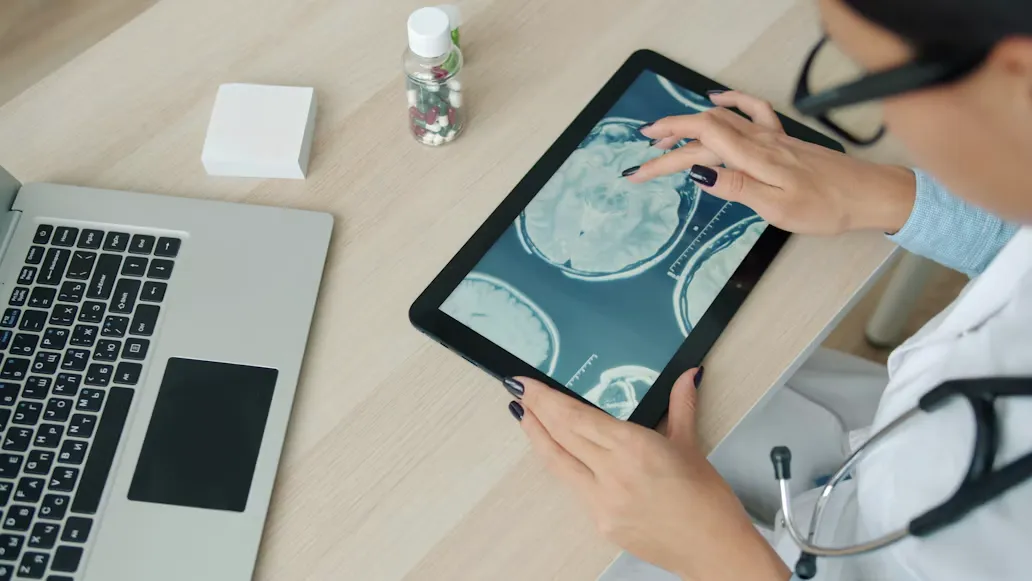
Ask most Ontario physicians what they like least about practice, and the answer is rarely the patients. It is the paperwork. Charting after clinic, chasing down documentation, and second-guessing whether a visit was billed correctly all eat into evenings and weekends. An AI medical scribe promises to shrink that load by listening to the visit and drafting the clinical note automatically.
The less obvious benefit is what better documentation does for billing. In Ontario, OHIP billing codes depend on what you did, how long it took, and what your record shows. A well-structured note supports the right claim. A thin or rushed note can lead to under-billing, or to trouble in an audit.
This article covers how AI medical scribes work, how they relate to OHIP billing codes, where they help, and where physicians still need to be careful.
What Is an AI Medical Scribe?
An AI medical scribe is software that listens to a patient encounter, with consent, and turns the conversation into a structured clinical note. Instead of typing while the patient talks, the physician can focus on the person in front of them. The tool transcribes the visit, identifies the clinically relevant content, and organizes it into a familiar format such as SOAP (Subjective, Objective, Assessment, Plan).
Most tools work in three steps:
-
Capture. The tool records audio through a phone, tablet, or computer, or the physician dictates a summary after the visit.
-
Transcription and summarization. Speech recognition converts the audio to text, and a language model sorts that text into note sections, filtering out small talk and repetition.
-
Review and export. The physician reads the draft, edits it, and pastes or pushes it into their electronic medical record (EMR).
That last step matters. The scribe drafts, but the physician signs. The note is still the physician’s legal and clinical record, and the AI is an assistant, not an author.
Many products also generate patient handouts, referral letters, and follow-up summaries from the same recording. That reduces the “pajama time” many physicians spend finishing documentation at home, which is the main reason adoption has grown so quickly across Canadian primary care and specialty practices.
Why Documentation and Billing Are So Tightly Linked in Ontario
In Ontario, physicians who bill the Ontario Health Insurance Plan (OHIP) submit claims using the Schedule of Benefits for Physician Services. Each claim generally includes a fee code describing the service, a diagnostic code describing the reason for the service, and other details such as the patient’s health number and the date of service.
The fee code is what most people mean by OHIP billing codes. They are alphanumeric codes where the letter often hints at the category of service. Some examples of code types physicians commonly encounter:
-
A-codes cover assessments and consultations. For example, A001 is a minor assessment, A007 is an intermediate assessment, and A003 is a general assessment.
-
K-codes cover many counselling, mental health, and structured care services. K013 is individual counselling, and K005 is primary mental health care, both billed by time units. K030 is associated with diabetes management.
-
G-codes and other procedure codes cover specific procedures and services, many of them with defined requirements.
Diagnostic codes in OHIP are separate from the fee codes and are usually three-digit codes. For example, 250 is used for diabetes, 401 for hypertension, 300 for anxiety, and 311 for depression. Choosing the diagnostic code that best reflects the main reason for the visit is part of a clean claim.
Here is where documentation enters the picture. Many fee codes come with conditions: minimum time thresholds, required elements of the history or exam, a specific type of patient relationship, or limits on how often a code can be billed. The note is the evidence that those conditions were met. If the claim says one thing and the chart says another, that mismatch can trigger a query or a recovery of payment.
Fee codes, rules, and amounts change with each update to the Schedule of Benefits, so always confirm current details with the Ministry of Health and your professional association rather than relying on any article, including this one.
Where an AI Medical Scribe Can Help With OHIP Billing Codes
An AI scribe does not submit claims, and it should not decide what you bill. But it can make billing decisions easier and better supported in several ways.
1. Capturing time-based services accurately
Many counselling and mental health codes depend on time. K013 and K005, for example, are billed in units, and the documentation should reflect that the required time was actually spent in direct counselling. Physicians who chart from memory at the end of the day often record only “counselled patient” with no supporting detail.
A scribe that timestamps the encounter and summarizes what was discussed gives you a more defensible record: the start and end of the conversation, the topics covered, the strategies discussed, and the follow-up agreed to. You still decide whether the time meets the code’s requirements, but you are working from a real record rather than a hazy recollection.
2. Supporting the level of assessment
The difference between a minor assessment (A001), an intermediate assessment (A007), and a general assessment (A003) depends on what the service involved. Broadly, more comprehensive histories, examinations, and documentation support higher-level assessments.
Rushed notes tend to under-document. A physician may have taken a full history, reviewed medications, discussed risk factors, and explained a plan, yet the chart says only “follow-up HTN, BP fine, continue meds.” An AI scribe captures the conversation as it happened, so elements that would have been forgotten make it into the record. That does not mean every visit should be billed higher. It means the note reflects the work that was done, and the code should follow the work.
3. Reducing missed billing opportunities
Busy clinics regularly leave legitimate billings on the table. A patient raises a second problem at the end of a visit, a brief counselling conversation happens in the middle of a routine appointment, or a chronic disease element gets addressed without being recorded.
Because a scribe records the whole encounter, the draft note can surface things you talked about but might not have charted. When you review it, you can ask: was there a separately billable component here? If so, was it documented well enough to support the claim under the rules? Even if the answer is no, the review builds awareness of what is billable.
4. Improving diagnostic code selection
Diagnostic codes are easy to get wrong when you are working quickly. Physicians often default to a familiar code out of habit. A clear assessment section in the note, listing the actual problems addressed, makes it easier to choose the diagnostic code that matches the main reason for the visit and to notice when a visit covered more than one issue.
5. Creating a stronger audit trail
If OHIP queries a claim, or a physician is selected for a review, the clinical record is the first place anyone looks. Notes that are consistent, complete, and clearly linked to the services billed put the physician in a much stronger position than sparse notes that require interpretation. Structured AI-generated notes, once reviewed and corrected, tend to be more consistent from visit to visit, which helps.
6. Saving time on admin, which supports accuracy
Time saved on charting is time available to review claims, reconcile remittance advice, and follow up on rejections. Many physicians find billing errors happen when they are tired and behind. Reducing the documentation backlog reduces the conditions that produce errors.
The Limits: What an AI Scribe Cannot and Should Not Do
It is tempting to imagine that an AI scribe will simply “handle” OHIP billing. It will not, and physicians should be wary of any product that implies otherwise.
The physician remains responsible for every claim. Under OHIP rules, the billing physician is accountable for the accuracy of the claim. “The software suggested it” is not a defense. Any code suggestion should be treated as a prompt for your own judgment, not an instruction.
AI can make mistakes. Language models can misattribute a statement, omit a detail, or occasionally produce text that sounds plausible but was never said in the room. A note that says you performed an examination you did not perform, or discussed something that never came up, is a serious problem, especially if a claim depends on it. Careful review of every note before signing is not optional.
Avoid upcoding by convenience. A polished, detailed AI-generated note can make a visit look more substantial than it was. If the note is more elaborate than the encounter, the mismatch is a risk. The note should describe what happened, not what would support a higher fee code.
Rules are specific and change. OHIP billing has detailed conditions, exclusions, and frequency limits. A general-purpose AI scribe is not a substitute for reading the Schedule of Benefits, following Ministry bulletins, or asking your professional association or billing specialist when a situation is unclear.
Templates are not evidence. Some tools insert boilerplate text. Boilerplate that does not match the actual visit is worse than no text at all, because it can appear to document things that did not occur.
Privacy, Consent, and Compliance in Ontario
Recording a clinical encounter raises privacy obligations that physicians need to take seriously. In Ontario, personal health information is governed by the Personal Health Information Protection Act (PHIPA), and the Information and Privacy Commissioner of Ontario has published guidance relevant to AI tools in health care. The College of Physicians and Surgeons of Ontario (CPSO) also expects physicians to protect confidentiality and maintain accurate records regardless of the technology used.
Some practical points to consider:
-
Get informed consent. Tell patients that an AI tool is being used, what it does, and whether audio is recorded or deleted after transcription. Let them decline without penalty, and document their choice.
-
Understand where data goes. Ask vendors where data is stored, whether it stays in Canada, how long audio and transcripts are retained, and whether your patients’ information is used to train models.
-
Check security measures. Look for encryption in transit and at rest, access controls, and audit logs.
-
Review vendor agreements. Vendors that handle personal health information typically act as your agent or service provider, so the contract should reflect PHIPA obligations.
-
Look at provincial programs. Ontario has supported AI scribe initiatives through provincial partners such as OntarioMD, which has included evaluation of vendors against privacy and security expectations. Check current program details, since offerings and eligibility evolve.
Your malpractice protection provider, such as the CMPA, can also offer guidance on the medico-legal side of AI-assisted documentation.
How to Choose an AI Medical Scribe With Billing in Mind
If accurate OHIP billing is a priority, these questions help separate useful tools from generic ones:
-
Does it integrate with your EMR? Direct integration with the systems Ontario physicians commonly use reduces copy-and-paste errors and saves time.
-
Does it support Canadian and Ontario conventions? Spelling, terminology, medications, and referral patterns should suit Canadian practice.
-
Can it customize note structure by visit type? A counselling visit, an annual physical, and a chronic disease follow-up need different documentation.
-
Does it capture timing? For time-based codes, a visible record of visit length is valuable.
-
Is the review process simple? If editing is painful, physicians will skip it, and unreviewed notes are risky.
-
How transparent is the vendor about accuracy and errors? Ask for evidence, not marketing.
-
What are the privacy terms? Data residency, retention, and training use should be clear in writing.
-
What does it cost against time saved? Pilot with a small group before committing across a clinic.
A Practical Workflow for Ontario Clinics
Here is a simple pattern that many clinics find works well:
Before the visit: Confirm and document patient consent to use the scribe.
During the visit: Speak naturally, and say clinically important things out loud, such as examination findings, so they are captured.
After the visit: Review the draft note promptly, ideally the same day. Correct errors, delete anything that was not said or done, and add anything the tool missed.
Before billing: Match the documented services to the fee code requirements. Check time thresholds, required elements, and diagnostic code accuracy against the current Schedule of Benefits.
Periodically: Audit a sample of your own notes and claims. Look for patterns of under-documentation, over-documentation, or repeated coding errors, and adjust your workflow or scribe settings accordingly.
The Bottom Line
An AI medical scribe will not fix OHIP billing on its own, but it can address one of the biggest root causes of billing problems: incomplete, delayed, or vague documentation. By capturing the full encounter, supporting time-based services, and giving physicians a more consistent record, a good scribe helps the chart tell the same story as the claim.
The keys to using one well are simple. Get patient consent, choose a vendor with strong privacy practices, review every note before signing, and let the documented work drive the fee code and diagnostic code, never the other way around. Used that way, an AI medical scribe can give Ontario physicians back time and make their OHIP billing codes easier to defend.
This article is for general information only and is not billing, legal, or privacy advice. Confirm current OHIP billing codes and rules with the Ministry of Health, the Schedule of Benefits, and your professional association.